Nexora Pest DefenseNexora Pest Defense

Thermal Structural Bed Bug Eradication Los Angeles

Targeting bed bug colonies through surface-level pesticide sprays often triggers harbor dispersal, forcing insects deeper into wall voids and subflooring where chemical residuals degrade. Thermal structural bed bug…
Get My Free Estimate →(738) 203-6371
Thermal Structural Bed Bug Eradication in Los Angeles, CA
Quick answer
  • What is included: Site pre-inspection, placement of industrial convective heaters and wireless thermal probes, whole-structure heat elevation to lethal thresholds, continuous monitoring, and post-treatment thermal verification.
  • How fast it deploys: Inspection and setup occur within 24 to 48 hours of initial triage, with structural heat holding times running 4 to 8 hours depending on square footage.
  • What it costs: Ballpark pricing ranges from $1,200 for single-room containment up to $4,500 for whole-home deployments, with an absolute structural inspection minimum of $200.
  • Targeted materials: Mattresses, wall voids, baseboards, upholstered furniture, floor joints, electrical conduits, and personal textiles without chemical residue.
  • How to schedule: Confirm property readiness and book structural assessment by calling (738) 203-6371.

Targeting bed bug colonies through surface-level pesticide sprays often triggers harbor dispersal, forcing insects deeper into wall voids and subflooring where chemical residuals degrade. Thermal structural bed bug eradication resolves this by converting the dwelling into an insulated convection chamber. Industrial heaters push heated airflow through framing lumber, soft furnishings, and structural crevices, reaching the thermal death point of 122°F (50°C) across all adult insects, nymphs, and embryonic eggs. Unlike synthetic pyrethroid treatments that require 3 to 4 sequential applications spaced 14 days apart to intercept newly hatched instars, controlled heat penetrates concealed micro-habitats in one continuous 6- to 8-hour hold phase. The operational trade-off centers on preparation intensity: occupants must remove pressurized aerosols, vinyl window blinds, wax-based artwork, and heat-sensitive prescription compounds from the target envelope prior to deployment.

Building architecture dictates specific heat dispersal engineering across distinct Los Angeles County microclimates. Multi-unit pre-war apartment buildings along Wilshire Boulevard in Koreatown and hillside residences in Silver Lake and Echo Park feature lath-and-plaster assemblies alongside dense interior dead spaces, requiring auxiliary high-velocity fans to eliminate cool interior pockets below the 120°F threshold. In concrete-slab mid-century constructions throughout North Hollywood and Sherman Oaks, radiant concrete floor loss absorbs convective energy, requiring thermal barrier mats across ground contacts. High-humidity marine layer zones in Pacific Palisades and Venice alter thermodynamic load requirements compared to arid inland canyon parcels near Griffith Park or older brick foundations throughout Boyle Heights. Structural envelope volume directly determines the British Thermal Unit (BTU) capacity needed, with high-output mobile diesel-electric generation rigs powering clean, duct-driven indoor air handlers without drawing from unstable residential circuits.

1. Structural diagnostic inspection: Nexora Pest Defense maps insect density using infrared imaging and confirms baseline temperatures across baseboards, closets, and structural perimeters.

2. Protective prep verification: Heat-sensitive items, cosmetics, medicines, and volatile materials are relocated out of the heating perimeter.

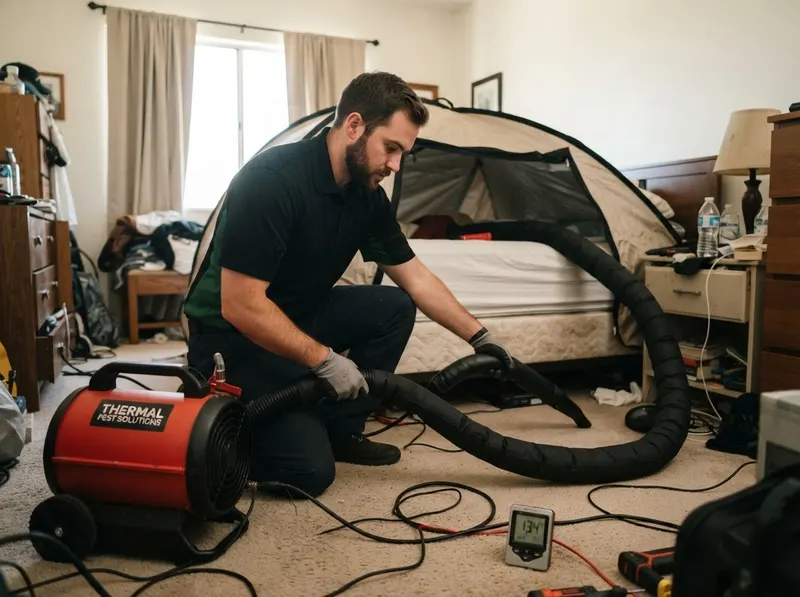
3. Thermal equipment deployment: Convective heat trailers position high-output ducting into target doorways, supported by remote digital sensor arrays anchored throughout deep wall cavities.

4. Lethal plateau sustainment: Internal ambient air reaches between 122°F and 135°F, sustained for an unbroken 4 to 8 hours to ensure deep core penetration into mattresses, framing, and subfloor materials.

5. Controlled cool-down and inspection: Air handlers switch to exterior ventilation, and real-time sensor logs confirm that every structural zone achieved full thermal mortality.

Thermal Structural Bed Bug Eradication cost in Los Angeles

Baseline Inspection & Sensor Diagnostic (Minimum Callout)$200
Single Room or Studio Apartment Thermal Remediation$1,200 - $1,800
2-Bedroom Multi-Unit Residence / Townhome$1,800 - $2,800
3-to-4 Bedroom Single-Family Home (Whole Structure)$2,800 - $4,500
Multi-Unit Commercial / Hospitality Clearance (Per Unit)$950 - $1,500

Every job gets a firm, written price after a free on-site visit.

Common questions

How does thermal structural bed bug eradication compare to chemical spraying in Los Angeles properties?
Thermal eradication reaches the lethal core temperature of 122°F across wall studs, mattresses, and furniture joints in a single 6-to-8-hour window, whereas chemical spraying requires multiple applications over 30 to 45 days and fails to penetrate unhatched bed bug egg casings.
Is the $200 minimum assessment credited toward whole-home heat treatment in Los Angeles County?
The $200 minimum charge covers the exhaustive on-site diagnostic, sensor placement map, and electrical assessment across Los Angeles County properties, and Nexora Pest Defense applies that balance directly toward the final invoice when thermal remediation proceeds.
Can heat treatments be safely executed in historic or hillside Los Angeles homes?
Yes, technicians deploy flexible high-temperature ductwork and portable generator trailers designed for narrow hillside streets in Silver Lake, Los Feliz, and Brentwood, isolating the building envelope without taxing local structural wiring.
What belongings must be removed from a Los Angeles home prior to structural heating?
Residents must remove pressurized cans, ammunition, fire extinguishers, wax candles, oil paintings, musical instruments, fresh produce, and all prescription medications, as structural indoor air temperatures reach up to 135°F.
How soon can residents re-enter a Los Angeles property after thermal structural bed bug eradication?
Re-entry occurs approximately 2 to 4 hours after equipment shutdown, once forced ventilation lowers the ambient interior temperature below 85°F and infrared scans verify zero lingering heat pockets.
Helpful resources

Trusted references & local links

USA.gov, government & consumer helpBetter Business BureauFTC Consumer AdviceU.S. Small Business AdministrationReady.govU.S. EPAENERGY STARU.S. Dept. of EnergyConsumer.govU.S. Census BureauGoogle Maps, Los Angeles, CA

Get started today

Tell us about your thermal structural bed bug eradication job in Los Angeles and we'll send a clear, written quote, usually the same day.

Get your free PEST CONTROL SEVICE quote, Los Angeles

We only use your ZIP to check availability, no spam.